Do you remember when Vanity Fair had that article about how all white men in Hollywood look the same now?
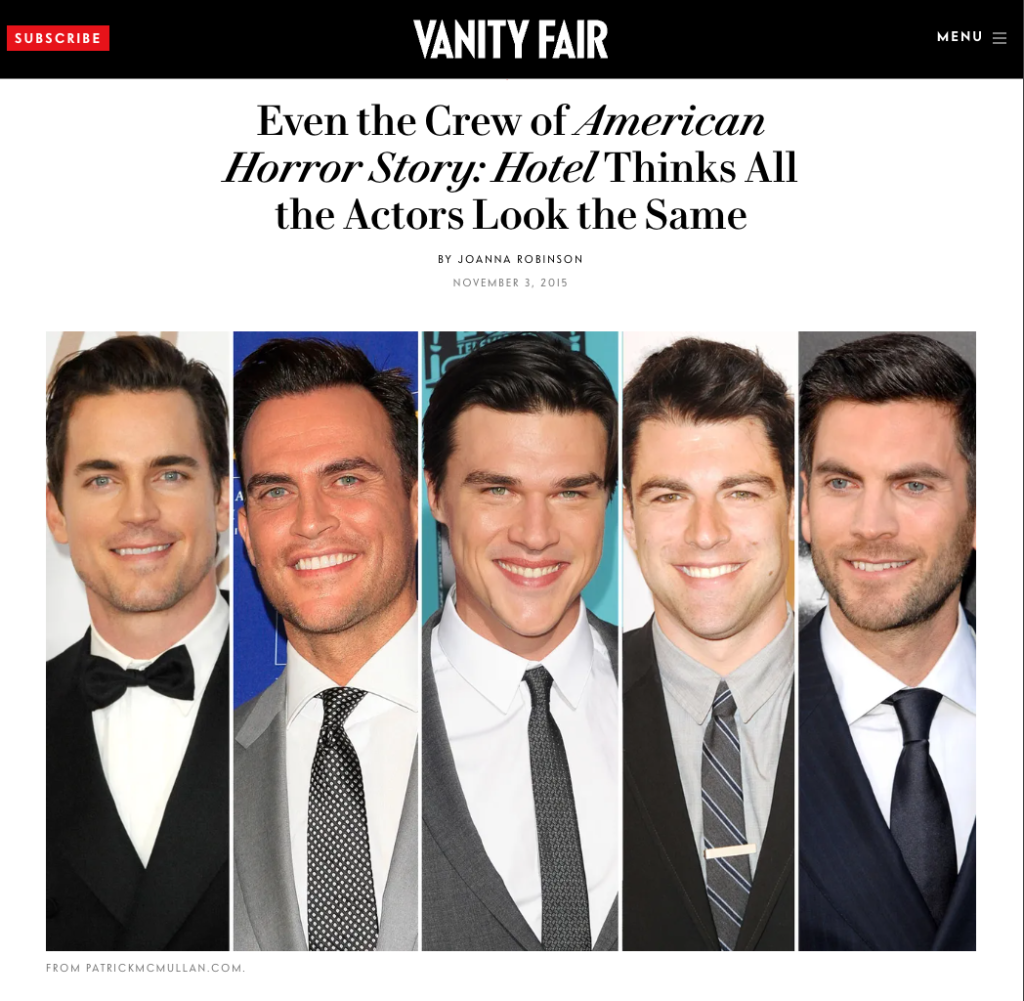
Image Description: A screenshot of a Vanity Fair article called “Even the Crew of American Horror Story: Hotel Thinks All the Actors Look the Same. From left to right, the actors depicted are Matt Bomer, Cheyenne Jackson, Max Greenfield, Wes Bentley, and Finn Wittrock. The image represents and makes clear the insight that there are lots of white dudes who get to be super famous actors, not because they’re all uniquely handsome and talented, but because they look like the kind of white man who gets a leading role in a movie or tv show.
Roxane Gay talks often in interviews about how she misses deadlines frequently. I also miss deadlines frequently. The difference between our two scenarios is that Roxane Gay is one of the best essayists, memoirists, and novelists of her generation, and I’m a regular ass Black kid in grad school who does pretty ok, but not (yet?) spectacular work. George R.R. Martin has famously spent nearly 3 decades writing the next installment of Game of Thrones, all while becoming a millionaire off the intellectual property of his incomplete series. It seems like you’re one of the best at what you do, you’ve earned the right to miss deadlines, and take the time you actually want/need to get your work done.
Maybe it’s that once your work gets to a certain level of good, people will wait for it without bothering you to hurry up.
Or maybe it’s that, in order to be considered that good in the first place, you’ve already produced so much value for your workplace, or the work around you, or public discourse, or the status quo, that it seems preferable to give you what you need in order to do more good work, than it is to micromanage you.
Roxane Gay had already written multiple gorgeous novels and short story collections before Bad Feminist took the world by storm. She didn’t “come out of nowhere”. She was working really hard for a really long time, and by the time she was famous, she was already a master at her craft, with a distinctive and moving literary voice.
Whatever the reason, it seems clear that what happens a non-trivial amount of the time is that, until you’ve proven yourself as worthy or whatever, most professionals and knowledge workers are not “given” or have not “earned” certain kinds of flexibility about how you get your work done. It is this structure – excellence first, flexibility and grace second- that is the ableist standard in need of interrogation.
I think the phenomenon of powerful missing deadlines, and us working-class and poor folks losing wages or social capital in our workplaces over missed deadlines, has a lot to tell us about how workplaces, including academia, can practice a form of flexibility that might be anti-racist and anti-ableist.
A lot of disabled folks have been talking about this all throughout quarantine. Their critiques have helped me notice the connection between the current public discourse about high-value workers who would rather quit their jobs than go back into the office, and the ableism that is upheld when we think that only very smart and accomplished people can miss deadlines for legitimate reasons.
Many of the accommodations that work places made when quarantine started were the very same accommodations that disabled professionals and knowledge workers have been self-advocating for as individuals and as coalitions, for decades. When all of a sudden, those same accomodations benefitted able-bodied and more neurotypical people, it was telecommuting, and flexibility with deadlines for everyone. All of a sudden, it’s not asking for too much to ask for more time to get something done. It’s not asking for too much to ask for something to be repeated multiple times in a meeting when it’s an exhausted neurotypical employee, rather than a disabled employee with poor working memory, or short term memory loss. A lot of our disabled comrades have pointed out that what is read as an unreasonable accommodation for a disabled person is often read as either a job perk, or a workplace amenity once it is deemed useful for a critical mass of able-bodied, neurotypical folks.
So now I ask, what might it mean for someone to have the grace and flexibility that very powerful people get, and that able-bodied people are assumed to merit, without having “earned” it? What could grace look like if it wasn’t something earned through years of toil, and spectacular feats of excellence?
This question should be especially pressing for those more radical folks who are already generally skeptical of how capitalist imperialist white supremacy structures what kind of work even gets to be considered excellent enough to “merit” the accoutrements of middle-class knowledge work in the first place. No one is giving the best plumber in the world a MacArthur Genius grant, and it’s not because plumbers don’t do valuable, important, and difficult work. A plumber who’s late to a non-emergency job is more likely to get a bad Yelp review than a thoughtful consideration of what personal and socio-political factors might have resulted in their lateness.
The parameters and constraints of how the work you do is valued, is organised not just economically in terms of wage, but also socially in terms of the accolades that are possible, and the social prestige one might be able to earn.
We need better answers for what happens when we whose bodies are not just Black but also chronically fatigued, or struggling with short term memory loss, or needing to go to the toilet more than an able-bodied person thinks is appropriate, show up (late!) to work. I am imagining a place where, for example, a disabled or neurodivergent Black person could have a career where they publish an average amount of papers, all of which were mostly just OK, and missed deadlines frequently, all without ever being judged for doing so. I think at least one part of a better answer is that we deserve to get a fair shot at an academic career without needing to be the smartest, most productive, and cleverest person in the room.
What might it look like to invest deeply in Black people before we ever “prove” ourselves to be “excellent”? What would the world need to look like if every young disabled or neurodivergent Black person got treated like the next Roxane Gay or George R.R. Martin?
Could we bring ourselves to do so if they turned out to be perfectly average at whatever they do?
I suspect for most people, Black, NBPOC, and white alike, the answer is no.
What, if anything, does that hypothetical no tell us about Black freedom?
Leave a Reply