NB: I originally wrote this article in 2020, before Twitter was bought by the wealthiest fascist in the world. Many of us have left the platform, and the links to the original tweets no longer work. But the ideas in the tweets and the conversation remain evergreen. I’ve decided to leave the original links for citational clarity. However, don’t take that to mean that I like, endorse, or use Twitter anymore. I won’t even use its new name. What follows is what I originally wrote.
My dissertation project, and research more broadly, is highly interdisciplinary. For me, the most difficult thing about interdisciplinary work so far has been figuring out where to start, where to end, and how to delineate my scope.
So imagine my joy yesterday when ole miss Al Gore Rhythm over at the Twitter pushed a very helpful thread started by Dr. Travis Chi Wing Lau to my timeline.
Dr. Lau asked:
“Academic hivemind: what are your favorite introductions in an interdisciplinary monograph that really models how the author is not only putting into conversation these different fields but also intervening in them?”
And thank goodness for the generosity of his followers, because they came with an abundance of examples! Some of these were already on my bookshelf here at home, or on my to-read list, while others were completely new to me. Luckily, many of them have introduction chapters that can be read for free online.
This thread also opened up space for the tagged authors mentioned in the thread to reflect on what it was like to write the work being lauded publicly.
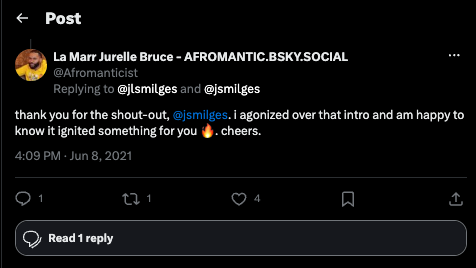
Dr. La Marr Jurelle Bruce, author of How To Go Mad Without Losing Your Mind (on this list) shared that he agonized over his introduction. The tweet reads “thank you for the shout-out, @jsmilges. i agonized over that intro and am happy to know it ignited something for you. cheers.”
I am currently agonizing over my own work, let me tell you! I am at a stage in my process where I feel a complicated mix of resentment and determination every time I click on my word processor. So Dr. Bruce’s tweet was a nice reminder that I’m in this for the long haul and I have to think about the challenges of writing like someone who will be doing this for a long time, and not someone stuck in a single project that will never end and also kill me, but not before turning me into a shell of my former self and making me cry all the time. (Haha just kidding…or am I?!). In all seriousness, I have read How to Go Mad Without Losing Your Mind and as a young scholar, it is truly a balm on my tired soul to know that I struggle with writing introduction sections for my work because it is a difficult thing to do, and not because I am secretly very stupid.
It’s uncommon for successful academics to talk about the actual process of writing, so I am always grateful for the vulnerability of my more senior colleagues in academia who are willing to share honestly about the lived experience of producing valuable work.
I’ve gathered all the books people named in the thread into a Zotero collection, as well as listed it out below in plain text. If I missed any, let me know in the comments. I’ll go back and add them, as well as update the link to the RDF.
Here is the interdisciplinary intros RDF.
Also, let me know if you’d like a reading buddy or book club for one or more of these. I plan to spend some time over the next several months sitting down and studying these intro chapters strategically to map out how these authors enter into their debates, and position themselves within the discourses. Maybe we could read an introduction and meet to talk about it on zoom or via email, or something of the sort? I have no idea if it’s even wise to make such an offer to internet strangers. I figure, if it goes terribly I’ll have learned a valuable lesson and never do such a thing again. Maybe I’ll just put up a follow up blog post where I present a content analysis and framework of what I find. I’ll probably just go with whatever of these two options gets the most traction.
The Full List of Books Recommended in Response to Dr. Lau’s Tweet.
Where available, I have linked directly to the introduction chapters on the publisher websites. Otherwise, I have linked to the publisher’s page of the book.
- Boisseron, Bénédicte. Afro-Dog: Blackness and the Animal Question. Columbia University Press, 2018. Intro chapter available through publisher
- Brock Jr., André . Distributed Blackness: African American Cybercultures. NYU Press, 2020.
- Bruce, La Marr Jurelle. How to Go Mad without Losing Your Mind: Madness and Black Radical Creativity. Duke University Press, 2020. Intro chapter available through publisher
- Byrd, Jodi A. The Transit of Empire: Indigenous Critiques of Colonialism. U of Minnesota Press, 2011.
- Crawley, Ashon T. Blackpentecostal Breath: The Aesthetics of Possibility. Fordham Univ Press, 2016. Intro chapter available through publisher
- Dimock, Wai-chee, and Lawrence Buell, editors. Shades of the Planet: American Literature as World Literature. Princeton University Press, 2007.
- Dorner, Zachary. Merchants of Medicines: The Commerce and Coercion of Health in Britain’s Long Eighteenth Century. University of Chicago Press, 2020.
- Ellcessor, Elizabeth. Restricted Access: Media, Disability, and the Politics of Participation. NYU Press, 2016. Intro chapter available through publisher
- Eyman, Douglas. Digital Rhetoric: Theory, Method, Practice. University of Michigan Press, 2015.
- I was able to access the intro chapter here, but I am not sure if that was because it’s actually available publicly or if I was just automatically routed through my university’s proxy since I was already signed in to my own library account.
- I was able to access the intro chapter here, but I am not sure if that was because it’s actually available publicly or if I was just automatically routed through my university’s proxy since I was already signed in to my own library account.
- Farr, Jason S. Novel Bodies: Disability and Sexuality in Eighteenth-Century British Literature. Rutgers University Press, 2019. Intro chapter available through google books
- Figueroa-Vásquez, Yomaira C. Decolonizing Diasporas: Radical Mappings of Afro-Atlantic Literature. Northwestern University Press, 2020.
- Givens, Jarvis R. Fugitive Pedagogy: Carter G. Woodson and the Art of Black Teaching. Harvard University Press, 2021.
- Hunt-Kennedy, Stefanie. Between Fitness and Death: Disability and Slavery in the Caribbean. University of Illinois Press, 2020.
- Jackson, Zakiyyah Iman. Becoming Human: Matter and Meaning in an Antiblack World. NYU Press, 2020.
- King, Tiffany Lethabo. The Black Shoals: Offshore Formations of Black and Native Studies. Duke University Press, 2019. Intro chapter available through publisher
- Love, Heather. Feeling Backward: Loss and the Politics of Queer History. Harvard University Press, 2009.
- Lowe, Lisa. The Intimacies of Four Continents. Duke University Press, 2015.
- Martinez, Aja Y. Counterstory: The Rhetoric and Writing of Critical Race Theory. Conference on College Composition and Communication, 2020. small portions available on the amazon ebook preview
- McKay, Richard A. Patient Zero and the Making of the AIDS Epidemic. University of Chicago Press, 2017.
- Muñoz, José Esteban. Cruising Utopia: The Then and There of Queer Futurity. 10th Anniversary Edition, New York University Press, 2019.
- Noble, Safiya Umoja. Algorithms of Oppression: How Search Engines Reinforce Racism. NYU Press, 2018. Intro chapter available through publisher
- Okiji, Fumi. Jazz As Critique: Adorno and Black Expression Revisited. Stanford University Press, 2018.
- Omi, Michael, and Howard Winant. Racial Formation in the United States. Third edition, Routledge/Taylor & Francis Group, 2015.
- Pickens, Therí A. Black Madness: : Mad Blackness. Duke University Press, 2019.
- Quashie, Kevin. The Sovereignty of Quiet: Beyond Resistance in Black Culture. Rutgers University Press, 2012. Intro available through google books
- Schalk, Samantha Dawn. Bodyminds Reimagined: (Dis)Ability, Race, and Gender in Black Women’s Speculative Fiction. Duke University Press, 2018. Intro available through publisher
- Shange, Savannah. Progressive Dystopia: Abolition, Antiblackness, and Schooling in San Francisco. Duke University Press, 2019. Intro available through publisher
- Sharpe, Christina Elizabeth. In the Wake: On Blackness and Being. Duke University Press, 2016. Intro chapter available through publisher
- Snaza, Nathan. Animate Literacies: Literature, Affect, and the Politics of Humanism. Duke University Press, 2019. Intro chapter available through publisher
- Snorton, C. Riley. Black on Both Sides: A Racial History of Trans Identity. University of Minnesota Press, 2017.
- Sobande, Francesca. The Digital Lives of Black Women in Britain. Springer Nature, 2020.
- Thomas, Ebony Elizabeth. The Dark Fantastic: Race and the Imagination from Harry Potter to the Hunger Games. NYU Press, 2019. Intro available through publisher
- Tsing, Anna Lowenhaupt. The Mushroom at the End of the World: On the Possibility of Life in Capitalist Ruins. Princeton University Press, 2015. Intro available through publisher
Leave a Reply